

Made In Great Britain

Direct from our factory

Free Next Day Delivery

On orders over £750

Product Test Results

All test results published

Expert Technical Advice

Call or chat with our team

Stops the Dust. Hardens the Floor.

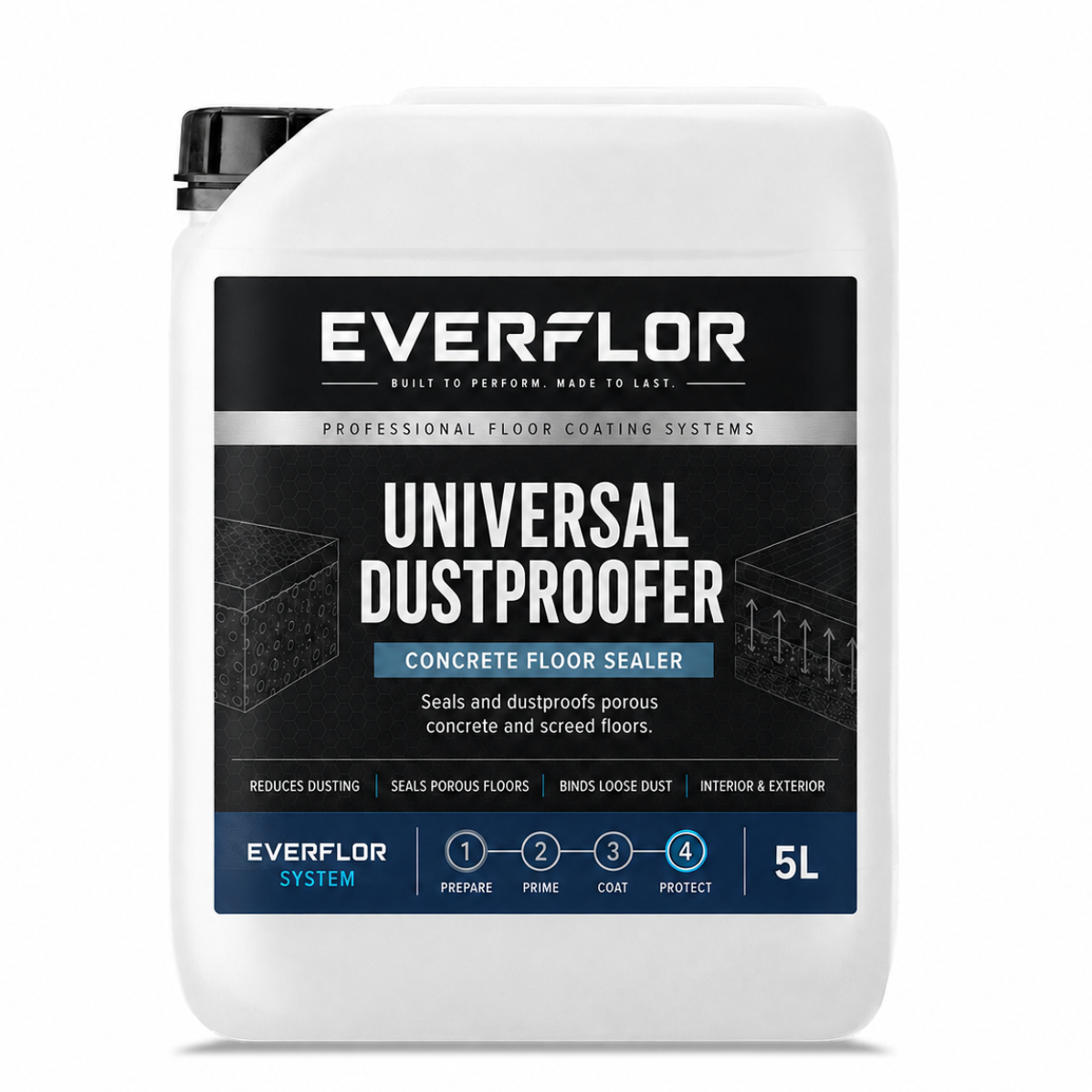
Weak screeds and poor quality concrete give up their surface a grain at a time. Foot traffic and wheels grind the top layer loose, and fine grey dust lifts off the floor as fast as it is swept away. A surface film only masks that; it sits on friable material and breaks up with it. This dustproofer is a colourless liquid resin that penetrates deep into the substrate and binds the loose layer from within, so the concrete itself is hardened and dustproofed. It is water based, virtually odourless and microporous, so the floor still breathes. One coat, straight from the container by brush, roller or spray, with no mixing and no thinning.
Click an icon to explore features Tap an icon to explore features

Optimized Curing Profile

Engineered for efficient application cycles. The coating becomes touch-dry in just 2–4 hours (temperature dependent), preventing debris pickup and allowing for a reliable, streamlined application process on large surface areas.

Hydrophobic Vapor Valve

The advanced acrylic lattice acts as a "one-way valve." It blocks rain and surface oils from penetrating downwards but allows trapped ground moisture to escape as vapor—preventing the bubbling and blistering common with standard floor paints.

Deep Penetration Hardening

Weak screeds and poor quality concrete release dust because the surface fines are not bound together. The colourless dual acrylic resin soaks into the open pores and hardens within them, binding the loose material into the slab. The result is a dustproofed, strengthened surface with reduced porosity on concrete, brick, blockwork and plaster.

Single Pack Application

Nothing is mixed, thinned or primed. Apply one coat by brush, roller or spray straight from the container at 6m² per litre, working between 5°C and 30°C, indoors or out. Clean tools in warm soapy water.

Performance Profile

Single-Pack Water Based Acrylic Dustproofer. A colourless penetrating resin that hardens and dustproofs porous concrete, screed and masonry. One coat is normally sufficient. Touch dry in two hours at 20°C, fully cured in twelve. Applied by brush, roller or spray with no mixing and no thinning.

Download Data Sheet
Coverage 6m²per litre, per coat
Coats 1Recommended
Touch Dry 2 hrsat 20°C
Finish ClearColourless

Essential Information

Product Details

Description

EverFlor Universal Dustproofer is a colourless liquid resin for porous concrete and similar absorbent materials. It penetrates deep into the substrate and binds the weak surface layer, so a floor that once released fine grey dust is left hardened and dustproofed. On brick, blockwork and plaster walls it reduces both porosity and dusting.

The product is a single pack, water based dual acrylic system. There is no solvent to flash off and it is virtually odourless, which makes it workable in occupied buildings. It is microporous, so the substrate can continue to breathe after treatment. It dries clear and leaves no colour change of its own.

No primer is required and no thinning is needed. Apply it as supplied by brush, roller or spray. One coat is normally enough. Because it reduces surface porosity, it is also useful as preparation on weak or dusty screeds before a floor coating is applied.

Recommended areas of use

  • Previously untreated concrete floors and screeds
  • Porous, bare concrete and sand and cement screeds
  • Brick and blockwork walls
  • Plastered walls that chalk or dust
  • Block paving
  • Interior and exterior surfaces

Features

  • Penetrates the surface to harden weak, dusty concrete rather than forming a film on top
  • Reduces porosity and dusting on brick, blockwork and plaster
  • Microporous, so the substrate continues to breathe
  • Water based and solvent-free, with a VOC content below 30 g/l
  • Virtually odourless, suitable for work in occupied areas
  • Colourless, so the appearance of the substrate is retained
  • Single pack with no mixing and no thinning; brush, roller or spray
  • Tools wash out in warm soapy water

Good to know

The substrate must be dry and absorbent for the resin to penetrate. If water poured on the surface is not taken in, the surface is too closed for treatment. Sweep off loose dust and dirt first, and remove oil and grease, then rinse and allow to dry. New concrete needs time to dry enough to absorb the liquid before treatment. Apply and store between 5°C and 30°C. Shelf life is 24 months.

Application

SURFACE PREPARATION

Little preparation is needed, but the surface must be dry and porous. Sweep the area to remove surface dust and dirt. Remove oil and grease with a suitable degreaser, rinse with water and allow the surface to dry.

Test absorbency if you are unsure. Pour some water onto the substrate: if it is absorbed easily, the surface is suitable. New concrete must first be dry enough to take up the liquid. No primer is required.

APPLICATION

Apply between 5°C and 30°C. Use as supplied — do not thin. Apply by brush, roller or spray, working the liquid well into the surface so the substrate absorbs as much as it can hold.

Avoid ponding. Do not let surplus unabsorbed liquid stand and dry on the surface; spread it out onto adjacent areas instead. One coat is normally sufficient. A second coat may be worthwhile on exceptionally porous substrates.

DRYING AND CURING

At 20°C the surface is touch dry in 2 hours and can be recoated after 4 hours. Allow 12 hours at 20°C for the cure to complete. Lower temperatures and poor drying conditions will extend all of these times.

CLEANING AND STORAGE

Clean brushes, rollers and spray equipment with warm soapy water immediately after use. Store unopened containers between 5°C and 30°C. Shelf life is 24 months.

Technical Data
Finish Clear
Coverage 6m² per Litre, Per Coat.
Recommended coats 1
Touch dry 2 Hours at 20°c
Recoat after 4 Hours at 20°C
Application Brush, Roller or Spray
Cleaner / Thinner No thinning.
Suitable substrates Porous, bare concrete, sand and cement screeds, brick, blockwork, plaster and block paving
Shelf life 24 months
VOC content < 30 g/l
Cleaning tools Warm soapy water
Number of components 1
Cure Time 12 hours at 20°C
Composition Single pack, dual acrylic system. Water based.
Primer required Not required.

The Knowledge Hub

Everything You Need to Know

Browse our collection of in-depth articles and how-to guides designed to help you get the most out of this product. whether you need help with surface preparation or application advice, we have you covered.

View Technical Hub

A visual comparison of a mossy, weed-infested block paving driveway next to a freshly cleaned section in the UK.
  • von Sam Marriott

Restoring Block Paving: Removing Moss, Weeds, and Lichen

Block paving is the most popular driveway choice in the UK, but it has a major design flaw: Joints. Those thousands of gaps between the bricks are the perfect nursery for weeds, moss, and the dreaded "black spot" lichen. Every...

Weiterlesen

An unbranded industrial floor scrubber being used to maintain the high-gloss shine on a polished concrete warehouse floor.
  • von Sam Marriott

Deep Cleaning Polished Concrete Without Damaging the Shine

Polished concrete is often sold as the "maintenance-free" flooring option. That is a lie. Yes, it is incredibly durable. It won't peel or flake like paint. But if you ignore it, or worse - if you clean it with the...

Weiterlesen

Two unbranded silver tins labeled Acid and Alkaline on an industrial concrete warehouse floor.
  • von Sam Marriott

Acid vs. Alkaline Concrete Cleaners: Which is Best for Your Floor?

If you walk into a hardware store and ask for "concrete cleaner," you'll probably end up with a few different options in-front of you. Most people grab the bottle with the most aggressive warning label, thinking "stronger is better." But...

Weiterlesen

How to Sand a Painted Concrete Floor for Recoating
  • von Sam Marriott

How to Sand a Painted Concrete Floor for Recoating

In our Sanding vs. Grinding: Preparing Previously Painted Concrete guide, we established that if your floor passes the Cross-Hatch Adhesion Test, then the next step for recoating will be sanding. Choosing to sand rather than grind saves you hundreds of pounds in equipment rental and diamond consumables....

Weiterlesen

FAQs

Please read our FAQs page to find out more.

How do I know whether my floor is porous enough to treat?
Pour a little water onto the surface. If it soaks in readily, the substrate is absorbent and the resin will penetrate. If the water sits on top, the surface is already sealed or too closed, and the product cannot do its job.
Do I need a primer first?
No. No primer is required and no thinning is needed. Sweep the surface clean, remove any oil or grease, let it dry, then apply the product as supplied.
How many coats should I apply?
One coat is the recommendation and is normally sufficient. A second coat may be worthwhile on exceptionally porous substrates. If you do apply a second coat, wait at least 4 hours at 20°C. Coverage is 6m² per litre per coat, so allow for the extra material.
Will it change the colour or look of the concrete?
No. The finish is clear and the resin itself is colourless, so the substrate keeps its own appearance. It is also microporous, which means the substrate can continue to breathe after treatment.
Can I use it outside, and how soon can the area be used?
Yes — it is suitable for interior and exterior use, including block paving, and can be applied to walls as well as floors. Apply between 5°C and 30°C. At 20°C the surface is touch dry in 2 hours and the cure is complete after 12 hours. Cooler or damper conditions extend both.

Didn’t find your answer?

Don't hestitate to contact us