

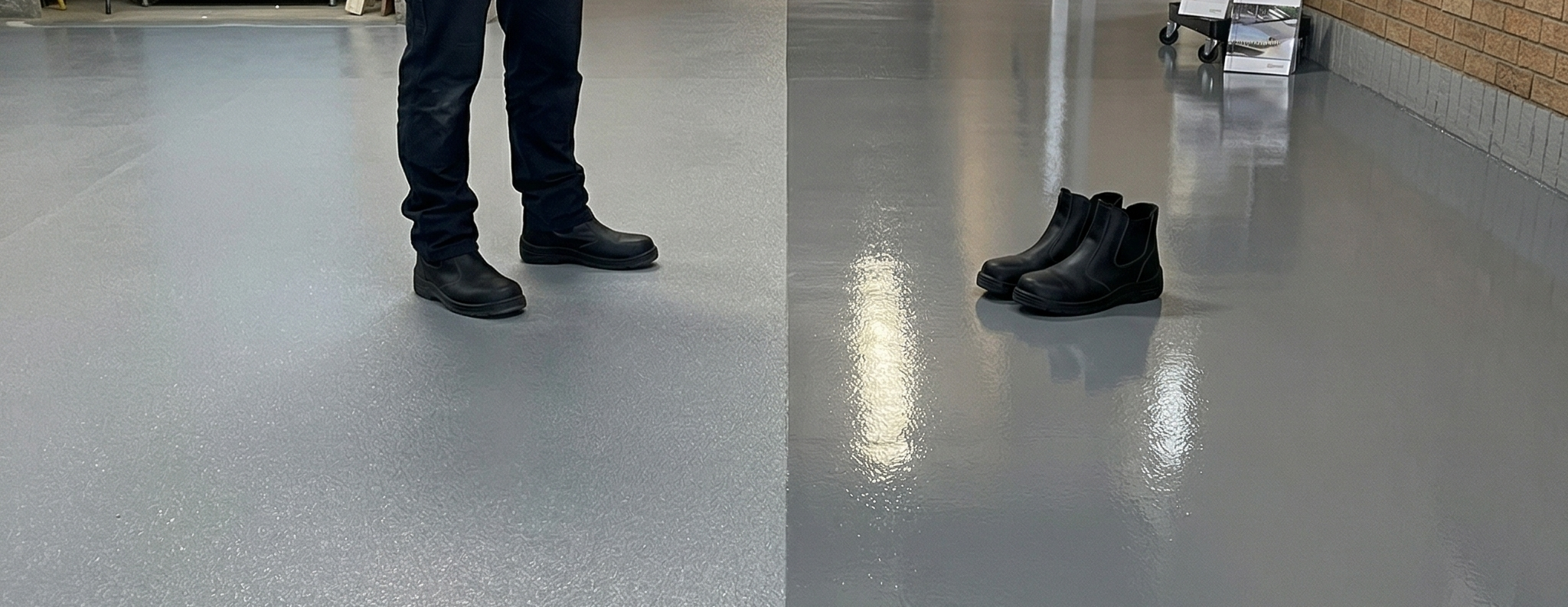
You have selected the perfect floor resin. You know exactly what colour you want. But right before you add it to your basket, you are faced with a crucial choice: Standard or Anti-Slip?
Painting a concrete floor seals the surface, making it look professional and stopping the dust. However, it also makes the concrete significantly smoother. Add wet shoes from bad weather, a spilled drink, or a few drops of oil, and that beautiful smooth floor immediately becomes a high risk slip hazard.
Whether you are protecting your family at home or your staff in a warehouse, slip hazards are a serious liability. Here is our straightforward guide to deciding if you need an anti-slip additive, and exactly which grade to choose.
1. Do You Really Need Anti-Slip?
Not every floor needs extra grip. A standard, smooth finish is perfect for dry, level environments like living rooms, dry storage rooms, or low-traffic showrooms where easy cleaning is the absolute top priority.
However, you must consider an anti-slip finish if your floor features any of the following:
-
Moisture: Areas exposed to rain, wet vehicles, or frequent washdowns.
-
Spills: Workshops handling oil, grease, or chemicals.
-
Gradients: Ramps, sloped driveways, or steps.
-
Public Access: Commercial spaces where you are legally liable for visitor safety.
2. The Benefits: Home vs. Industry
Adding an anti-slip aggregate (tiny particles suspended in the paint) provides distinct benefits depending on your environment.
In the Residential Space (Garages & Patios):
-
Winter Safety: When you drive a snow-covered or rain-soaked car into your garage, the water pools on the floor. Anti-slip paint gives your shoes the traction needed to step out of the car safely.
-
Outdoor Grip: Painted steps, pathways, and patios can easily become slippery when wet or even just covered in autumn leaves. A textured coating prevents painful falls at home.
In the Industrial Space (Warehouses & Workshops):
-
Forklift Traction: Smooth epoxy can cause forklift tyres to spin, especially near loading bay doors where rain blows in. Textured floors keep heavy machinery moving safely.
-
Health & Safety Compliance: Slips and trips are the most common cause of workplace injury. A designated anti-slip coating protects your staff and shields your business from liability claims.
3. Choosing Your Grade: Fine, Medium, or Coarse
Anti-slip additives are not "one size fits all." They come in different grades (particle sizes). Choosing the right one is about matching the grip to the footwear.
-
Fine Grade:
-
The Feel: Similar to very fine sandpaper.
-
Best For: Bathrooms, utility rooms, indoor residential stairs, and light-use pedestrian walkways. It provides a subtle grip that won't tear up bare feet or delicate shoes.
-
Medium Grade:
-
The Feel: Similar to the grip tape on a skateboard.
-
Best For: Domestic garages, driveways, patios, and general-purpose commercial workshops. This is the ultimate all-rounder. It provides excellent traction under boots and trainers without being overly aggressive.
-
Coarse Grade:
-
The Feel: Aggressive, sharp, and highly textured. (Do not walk on this barefoot).
-
Best For: Industrial loading bays, steep exterior ramps, commercial kitchens, and heavy forklift routes. It is designed to bite through grease, heavy mud, and standing water.
4. The Cleaning Trade-Off
Before you default to ordering the "Coarse" grade just to be safe; remember, everything in life has a tradeoff. With anti-slip flooring, the downside is that the more grip a floor has, the harder it is to clean.
-
Smooth Floors: Can be effortlessly wiped with a standard mop and bucket.
-
Fine/Medium Floors: Will require a bit more elbow grease and a heavier-duty mop to clean out the textured profile.
-
Coarse Floors: Will shred a traditional cotton mop to pieces. To clean a coarse industrial floor, you will need a stiff deck brush, a mechanical floor scrubber, or a pressure washer.
Do not buy a coarse anti-slip paint for a floor that needs to be mopped daily, unless you are prepared to change your cleaning routine. Always match the grade to your actual risk level.
Conclusion
An anti-slip floor coating is the cheapest insurance policy you will ever buy. By mixing a textured aggregate into your paint, you keep the durability of the coating while vastly improving the safety of the room.
-
Assess the water and oil risk.
-
Choose the grade that matches your footwear.
-
Balance your need for grip with your need for easy cleaning.
Ready to improve the safety of your space?
→ Shop our Range of Anti-Slip Paint Additives
→ Shop our Range of Anti-Slip Paint Packs
Share:
Best Paint for Dog Kennels? Why You Need Specialist Two-Pack Epoxy
Best Paint for Natural Stone Tiles? Why Water-Based Acrylic is the Only Choice