

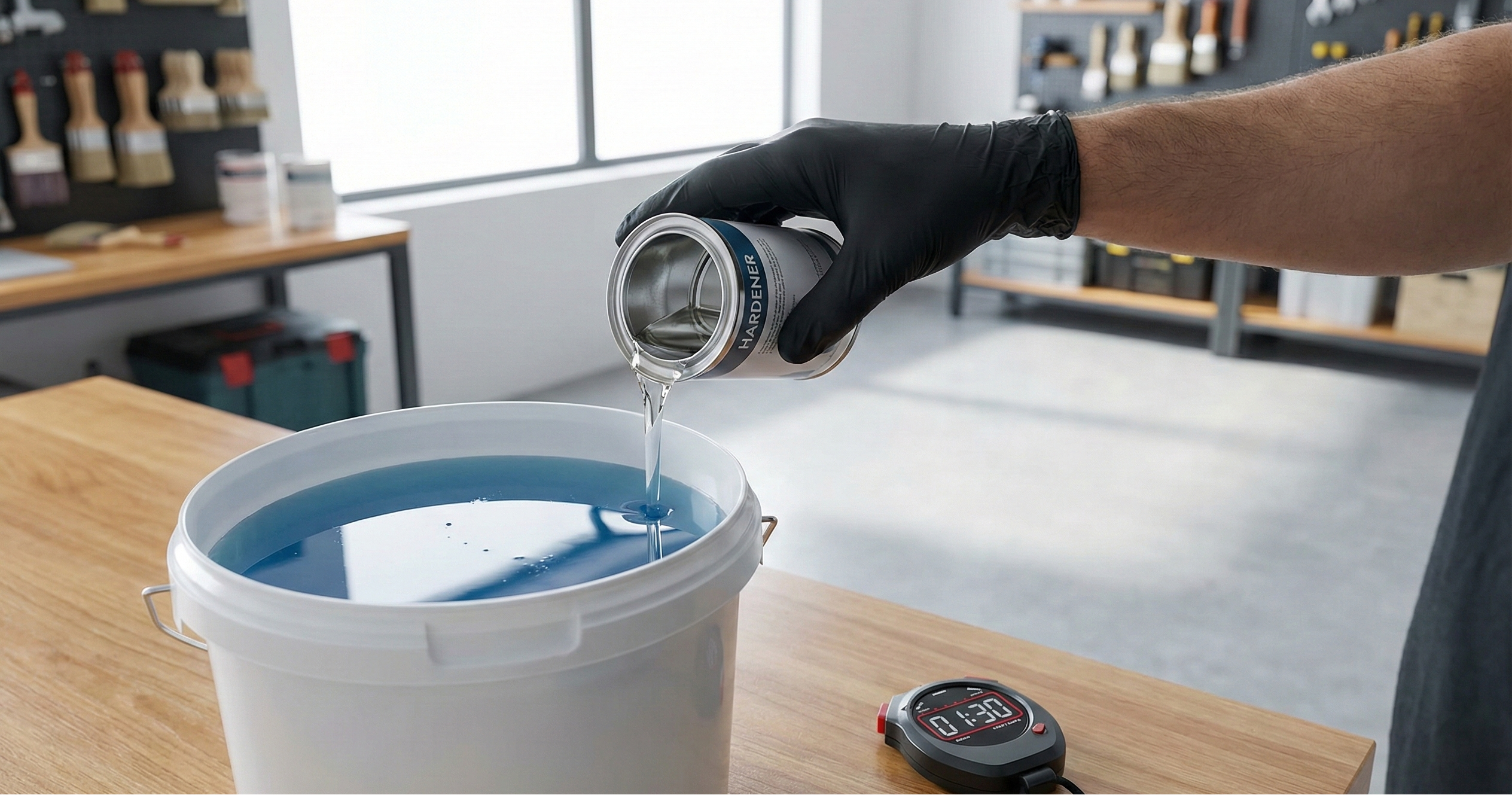
Le plus grand obstacle à surmonter entre l'utilisation d'une peinture bi-composant et d'une peinture mono-composant est la panique.
Lorsque vous utilisez de la peinture émulsion standard, vous pouvez ouvrir le pot, peindre un peu, aller déjeuner, revenir et continuer.
Lorsque vous utilisez une résine époxy bi-composant, vous êtes engagé dans une course contre un compte à rebours chimique connu sous le nom de durée de vie en pot.
Si vous vous trompez dans votre évaluation, vous ne gaspillerez pas seulement de la peinture ; vous vous retrouverez avec un seau de plastique solide et un rouleau ruiné.
Mais ne vous inquiétez pas. Une fois que vous comprendrez pourquoi la résine durcit, vous pourrez contrôler le temps.
Voici le guide pour maîtriser la durée de vie en pot et garder votre calme pendant l'application.
Qu'est-ce que la durée de vie en pot ?
La durée de vie en pot est le temps dont vous disposez pour appliquer le produit après avoir mélangé la Partie A (Base) et la Partie B (Durcisseur) avant qu'il ne devienne trop épais pour être utilisé.
Contrairement aux peintures à séchage à l'air, les résines époxy bi-composant durcissent via une réaction chimique. Cette réaction génère de la chaleur (connue sous le nom de réaction exothermique).
- Le cycle : Vous mélangez la résine → Les produits chimiques réagissent → La réaction crée de la chaleur → La chaleur accélère la réaction → La résine chauffe → La résine durcit.
L'« effet de masse » : pourquoi le seau est dangereux
Voici la règle d'or des revêtements de sol en résine : la résine déteste le seau.
Si vous mélangez 5 kg d'époxy et le laissez dans le seau en plastique, la chaleur générée par la réaction n'a nulle part où aller. Elle est piégée dans la masse du liquide.
- Résultat : La résine va « cuire » d'elle-même. Un produit avec une durée de vie en pot de 40 minutes pourrait se transformer en une brique fumante et bouillante en seulement 15 minutes s'il est laissé dans le seau.
La solution : Videz-le immédiatement.
Dès que vous avez fini de mélanger, versez la résine sur le sol en béton frais en une longue ligne (un cordon).
En étalant la résine, vous augmentez la surface. La chaleur peut s'échapper dans l'air et le béton froid, ralentissant considérablement la réaction et vous donnant tout le temps de travail.
L'importance de la température : été ou hiver
Le temps imprimé sur la boîte (par exemple, « 30 minutes ») est généralement basé sur une température de laboratoire de 20 °C.
La vie réelle nous offre rarement ces conditions de laboratoire de précision.
-
En été (25 °C et plus) : La chaleur alimente la réaction. Votre durée de vie en pot de 30 minutes pourrait se réduire à 15 minutes.
- Conseil : Gardez vos boîtes non mélangées dans une pièce fraîche ou un réfrigérateur avant de commencer.
-
En hiver (5 °C) : Le froid ralentit la réaction. Votre durée de vie en pot de 30 minutes pourrait s'étendre à 60 minutes.
-
Conseil : Bien que cela semble génial, s'il fait trop froid, la résine sera épaisse comme de la mélasse et difficile à rouler.
-
Conseil : Bien que cela semble génial, s'il fait trop froid, la résine sera épaisse comme de la mélasse et difficile à rouler.
Durée de conservation vs. temps de travail vs. temps de séchage vs. temps de durcissement
Il existe de nombreuses contraintes de temps essentielles que vous pourriez rencontrer concernant les peintures bi-composant. Voici une brève explication.
-
Durée de conservation : Il s'agit simplement de la date de « péremption » du liquide tant qu'il est dans la boîte non ouverte. Une fois cette date dépassée, les catalyseurs chimiques à l'intérieur peuvent mourir, ce qui signifie que la peinture pourrait refuser de durcir même si vous la mélangez parfaitement.
-
Durée de vie en pot : C'est votre compte à rebours urgent une fois le catalyseur mélangé. Parce qu'un seau plein de résine génère une chaleur intense (exothermique), il peut se solidifier en aussi peu que 20 minutes s'il est laissé dans le récipient. Vous devez verser le produit mélangé sur le sol immédiatement pour dissiper la chaleur et sauver le mélange.
-
Temps de travail : C'est la fenêtre dont vous disposez pour étaler la peinture une fois qu'elle est sur le sol froid. C'est généralement plus long que la durée de vie en pot, mais vous devez continuer à avancer ; si vous essayez de rouler à nouveau le revêtement une fois qu'il commence à devenir collant (adhérent), vous ruinerez la finition lisse.
-
Temps de durcissement : Cela définit la différence entre « sec » et « dur ». Bien qu'un sol puisse être suffisamment sec pour y marcher en chaussettes après 12 à 24 heures, il faut souvent 7 jours complets pour atteindre un « durcissement chimique ». Conduire une voiture chaude sur le sol avant la fin de cette période peut arracher le revêtement du béton.
Comparaison des chimies
|
Type de résine |
Temps de travail typique |
Caractéristiques |
|
Époxy standard |
20 à 40 min |
Le standard « tolérant ». Bon pour les débutants. |
|
Époxy à durcissement rapide |
10 à 20 min |
Stressant. Uniquement pour les professionnels expérimentés ou les petites réparations. |
|
Polyaspartique |
15 à 25 min |
Très rapide. Nécessite une équipe de deux personnes (une pour le mélange, une pour le rouleau). |
Conclusion : Comment survivre à la durée de vie en pot
-
Ne mélangez pas tout en une seule fois : Si vous avez un grand garage, ne mélangez pas les 3 pots. Mélangez-en un, appliquez-le, puis mélangez le suivant.
-
Mettez-le sur le sol : Ne laissez jamais la résine mélangée dans le seau pendant que vous discutez ou que vous masquez les bords. Versez et agissez.
-
Surveillez la température : S'il fait chaud, travaillez plus vite.
Prêt à commencer ?
→ Achetez nos peintures pour sols époxy
Partager:
Timing du retrait du ruban adhésif : comment obtenir des lignes nettes sans abîmer vos bords