

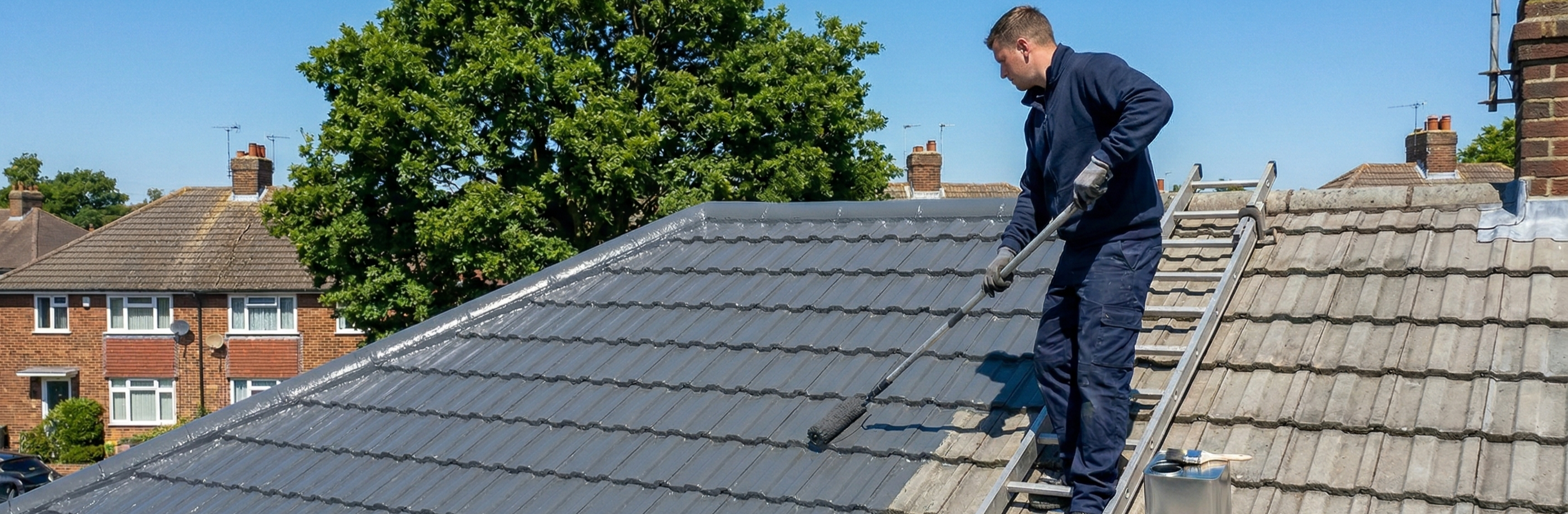
Because most roof tile paints are acrylic water-based products, the ability to form a durable, waterproof shield depends entirely on the evaporation of water over the drying period. If it rains, or if the humidity is too high before the paint has fully coalesced, the acrylic particles cannot fuse together. This leads to the paint washing off the tiles entirely, sagging, or developing a patchy, weakened finish. For a successful application, you must have a clear weather window that allows the paint to reach a rain-safe state, typically 24 hours (to be on the safe side) before any moisture hits the roof.
-
The Coalescence Phase: As water leaves the paint, the acrylic beads "melt" into one another to form a continuous, flexible membrane.
-
Wash-Off Risk: Unlike oil-based paints, wet water-based acrylics can be completely diluted and rinsed away by a sudden downpour.
-
The Solution: Monitor the 24-hour forecast for rain and humidity levels, ensuring the roof temperature remains well above the dew point throughout the drying process.
→ Shop Everest - PremFlex - Flexible Roof Tile Paint
The Science of Water-Based Drying: How PremFlex Sets
To understand the weather risk, you have to look at how PremFlex transforms from a liquid in the tin to a flexible "rubber-like" coating on your roof. This process is called coalescence.
In a water-based system, the acrylic resin is suspended in water as tiny droplets. As soon as you apply the paint to the tile, the water begins to evaporate. As the water disappears, these resin droplets are pushed together until they touch and eventually fuse into a solid, flexible film. If rain introduces more water into the film before this fusion is complete, the process is reversed; the droplets are pushed apart again, and the paint stays in a liquid, vulnerable state.
The Weather Culprits: What to Avoid
1. The "Flash" Rainstorm
A sudden summer shower is the biggest threat to a roof painting project. Because roof tiles are angled, rainwater gains velocity as it runs down the pitch. If the PremFlex hasn't reached its initial set, the rain will simply carry the wet paint down into your gutters.
-
The Fix: Never start a roof painting project if there is more than a 10% chance of rain within the next 8 hours.
2. High Humidity and "Trapped" Water
If the air is already saturated with moisture (high humidity), the water inside the paint has nowhere to go. Evaporation slows down or stops entirely.
-
The Problem: The paint may look "dry" on the surface, but the internal layers remain liquid. If the sun goes down and the temperature drops, the moisture stays trapped, leading to a soft, poor-quality finish that may bubble later.
3. The Dew Point Danger
In the early spring or late autumn, the roof surface can cool down rapidly in the late afternoon. If the tile temperature hits the Dew Point, moisture from the air condenses directly onto the roof.
-
The Problem: This microscopic layer of water forms under and on the paint film, breaking the bond with the tile and causing the paint to "blush" or lose its adhesion.
The Professional Application Window
To get the best performance out of a flexible coating like PremFlex, timing is everything.
-
Start Early, Finish Early: Aim to start painting by 9:00 AM once the morning dew has vanished. Try to finish your last coat by 2:00 PM. This gives the paint the warmest part of the day to complete the coalescence process before the evening dampness sets in.
-
Check the Wind: A light breeze is actually helpful for water-based paints as it moves saturated air away from the roof, speeding up evaporation. However, high winds can cause the paint to dry too fast on the surface, leading to "mud-cracking."
-
Temperature Range: Ideally, apply PremFlex when the ambient temperature is between 10°C and 25°C. If it is too cold, the acrylic particles will be too "stiff" to fuse together properly.
Honest Trade-offs: Flexibility vs. Sensitivity
The "Flex" Benefit: The reason we use an acrylic water-based system like PremFlex is for its incredible flexibility. Roof tiles expand and contract significantly in the sun; a stiff oil-based paint would crack, whereas PremFlex moves with the tile. The trade-off is that it is more sensitive to rain during its first few hours of life.
The Gutter Mess: If you experience a wash-off due to unexpected rain, your first priority is to flush your gutters and downpipes with plenty of clean water before the paint dries inside them. Once the paint is "set" in a gutter, it is very difficult to remove.
The Second Coat Timing: Because PremFlex is a high-build coating, the first coat must be fully dry before the second is applied. If you "trap" the moisture of the first coat under a second layer too soon, you extend the total drying time and increase the risk of weather damage.
Share:
Stubborn Moss and Lichen Growth on Roof Tiles