

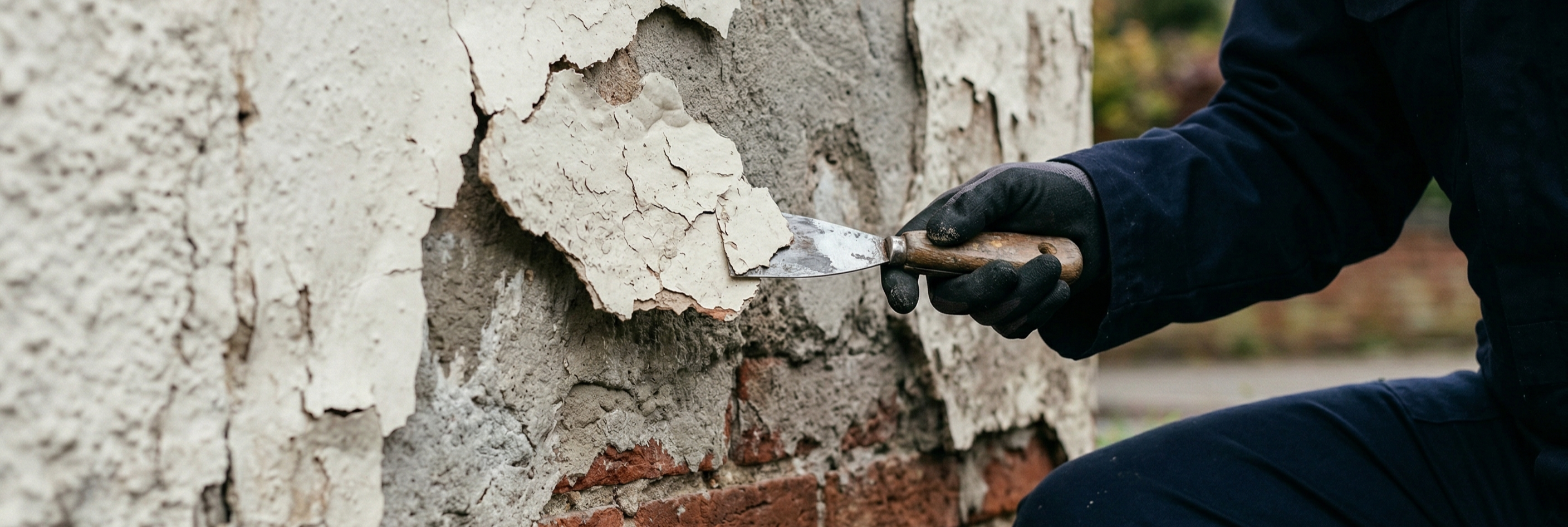
When masonry paint flakes off in chunks and you see the surface of the wall (sand, stone, or render) stuck to the back of the paint, you are witnessing a substrate failure. This isn't a case of the paint losing its grip; the paint is actually bonded so well that its internal strength exceeds the cohesive strength of the wall. As the wall surface crumbles or spalls due to age or moisture, it physically tears away, taking the paint with it.
-
Structural Decay: The outer layer of the brick or render has become friable, meaning the mineral bonds have broken down into loose particles.
-
The Anchor Problem: Paint needs a solid foundation; if the foundation is turning to dust, the paint has nothing stable to hold onto.
-
The Fix: You must remove the failing surface layer and use a deep-penetrating resin like PremTex Stabilising Primer to glue the masonry back together from the inside out.
→ Shop Everest - PremTex - Masonry Stabilising Primer
→ Shop Everest - PremTex - Smooth Masonry Paint
The Science of Substrate Failure
To understand why this happens, you have to look at the tensile strength of the paint versus the cohesive strength of the wall.
High-quality masonry paints like PremTex Smooth are designed to be tough and flexible. However, when these paints dry, they exert a small amount of tension on the surface. If the brick or render is old, porous, or has been damaged by the freeze-thaw cycle, the bond between the sand grains is weak. The paint effectively acts like a giant piece of adhesive tape; because it is stronger than the crumbling wall, it simply pulls the surface layer off when the wall moves or moisture builds up.
Why the Wall is Crumbling Under Your Paint
1. The Freeze-Thaw Cycle
Water enters the porous masonry and freezes. Since water expands by about 9% when it turns to ice, it physically snaps the mineral bonds holding the render or brick together. This creates a layer of loose, rotten masonry just beneath the surface.
2. Substrate Friability
Over decades, the lime or cement binder in render can wash away, leaving behind a sandy matrix. Even if the paint sticks to the top grains of sand, those grains are no longer connected to the rest of the wall.
3. Efflorescence Pressure
Salt minerals migrating through the wall can crystallise just beneath the paint film. As these crystals grow, they exert massive pressure that physically ruptures the face of the brick or stone, pushing both the masonry surface and the paint off in a chunk.
How to Fix a Crumbling Foundation
If the wall itself is failing, simply applying more paint will only result in more peeling. You have to restore the structural integrity of the masonry surface first.
Step 1: Remove the Dead Layer
Use a stiff wire brush or a scraper to remove the loose, crumbling masonry. You need to keep going until you hit a bright stone or firm render that doesn't turn to dust when you rub it.
Step 2: Consolidate with PremTex Stabilising Primer
This is the most critical step. Everest PremTex Stabilising Primer is a micronised resin with a very low molecular weight. It doesn't sit on the surface; it is pulled deep into the crumbling capillaries of the wall by suction.
-
The Glue Effect: As the primer cures, it acts as a chemical binder, gluing the loose sand and mineral particles back into a solid, rigid structure.
-
The New Foundation: Once the primer has consolidated the wall, you no longer have a friable surface. You have a stable, reinforced substrate that is ready to support the weight and tension of a new paint film.
Step 3: Apply the Topcoat
Once the wall is stabilised and dry (usually 24 hours), apply your PremTex Smooth Masonry Paint. Because the primer has re-built the surface of the wall, the paint now has a structural anchor that won't crumble away.
Honest Trade-offs: When Stabilising Isn't Enough
The Blown Render Limit: If you tap the wall and it sounds hollow, the render has completely detached from the brickwork behind it. A stabilising primer can fix a crumbling surface, but it cannot re-attach a whole sheet of render to a house. In this case, the render must be replaced.
Moisture Control: If the wall is crumbling because of a leaking gutter or rising damp, you must fix the water source first. If the wall remains saturated, the internal pressure will eventually find a way to break even a stabilised surface.
Share: