

You spot a rainbow-coloured puddle under your car. You move the vehicle and see a black, shiny patch of engine oil on your tarmac driveway. Your instinct is to grab the strongest chemical you have - Paint Thinner, Petrol, or heavy-duty Engine Degreaser - and scrub it off.
STOP. If you do that, you won't just remove the stain. You will remove the driveway.
Tarmac (Asphalt) is held together by Bitumen. Bitumen is a hydrocarbon - essentially, thick oil. Engine oil is also a hydrocarbon. In chemistry, there is a rule: "Like dissolves like." If you pour a solvent-based cleaner onto tarmac, it cannot tell the difference between the "Bad Oil" (the stain) and the "Good Oil" (the driveway). It dissolves both, leaving you with a sticky, crumbling hole that will never set hard again.
Here is how to safely remove the mess without melting the floor.
The Golden Rule: Absorb, Don't Rub
If the spill is fresh (still wet), speed is your friend. Oil acts as a solvent on asphalt. The longer it sits, the softer your driveway becomes.
-
Do Not: Rub it with a cloth. This just pushes the oil deeper into the porous surface.
-
Do: Absorb it. Dump a pile of Cat Litter, Sawdust, or Dry Sand onto the spill immediately.
-
Stamp it down to crush the powder into the texture.
-
Leave it for 24 hours to suck up the liquid.
- Sweep it away.
What NOT to Use
Before we look at the cure, check your cupboard. If you have any of these products, keep them away from your tarmac:
-
Petrol / Diesel: Will dissolve the binder instantly
-
White Spirit / Turpentine: Will soften the surface
-
Xylene / Solvent Thinners: Will strip the surface layer
-
Heavy Duty "Concrete" Degreasers: Often too aggressive
-
Boiling Water: Can soften the bitumen
The Solution: Biological Cleaners
The only way to attack oil without attacking bitumen is to use Biological Oil Removers. These cleaners don't use solvents. They use enzymes and bacteria.
-
How it Works: The bacteria naturally "digest" the lighter oil chains (diesel/engine oil) as a food source. However, they struggle to digest the heavy, hardened bitumen chains of the driveway.
-
The Process:
-
Pour the biological cleaner onto the stain.
-
Keep it wet. The bacteria need moisture to live. If it dries out, they stop working. Cover the area with a damp cloth or plastic sheet.
-
Wait. This is not an instant fix. It can take 24–48 hours for the enzymes to eat the oil.
-
Rinse. Wash away the residue.
The Detergent Method (For Light Stains)
If you can't wait for biological cleaners, you can use a mild Alkaline Detergent (like a biodegradable traffic film remover or diluted washing-up liquid).
-
The Trick: You are trying to lift the oil, not dissolve it.
-
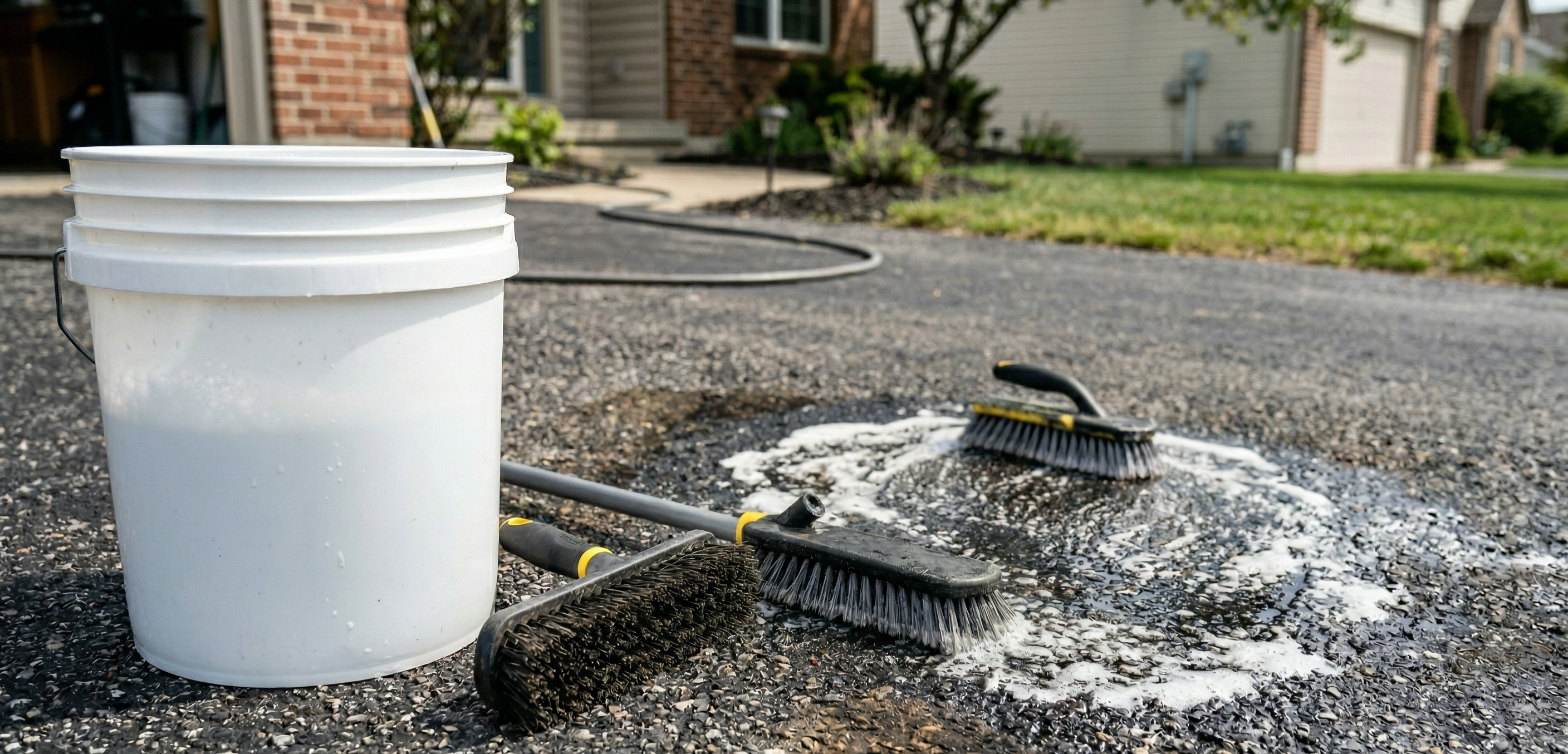
Agitation: Use a soft-to-medium brush. Do not use a wire brush (you will scrape the softened stones out).
-
Rinse Fast: Do not let the detergent sit on the tarmac for more than 20 minutes. Flush it with plenty of cold water to stop the chemical reaction.
Dealing with "Soft Spots"
Sometimes, you are too late. If you press your thumb into the stain and the tarmac feels like soft chocolate or putty, the chemical reaction has already happened. The oil has dissolved the binder. Cleaning will not fix this. In fact, cleaning might scrub the surface away entirely, leaving a hole.
The Fix:
-
Leave it alone: Sometimes, if the exposure was light, the oil will eventually evaporate and the tarmac will harden up again over 6-12 months.
-
Hardening Paints: You can buy "Tarmac Restorer" paints. Applying a heavy coat over the soft spot can seal the oil in and provide a new, hard crust on top.
-
Cut and Patch: If it is a deep mushy hole, the driveway is ruined in that spot. You must chisel out the soft material and fill it with Cold Lay Macadam.
Conclusion
Tarmac is delicate. It is an oil-based surface, and it is allergic to solvents. If you drop oil, soak it up with sand immediately. If a stain remains, trust biology, not chemistry.
-
Grab the cat litter
-
Use an Enzyme Cleaner
-
Never use solvents
Share:
How to Clean Oil and Rust Stains on Block Paving
Pressure Washing and Degreasing Before Sealing