

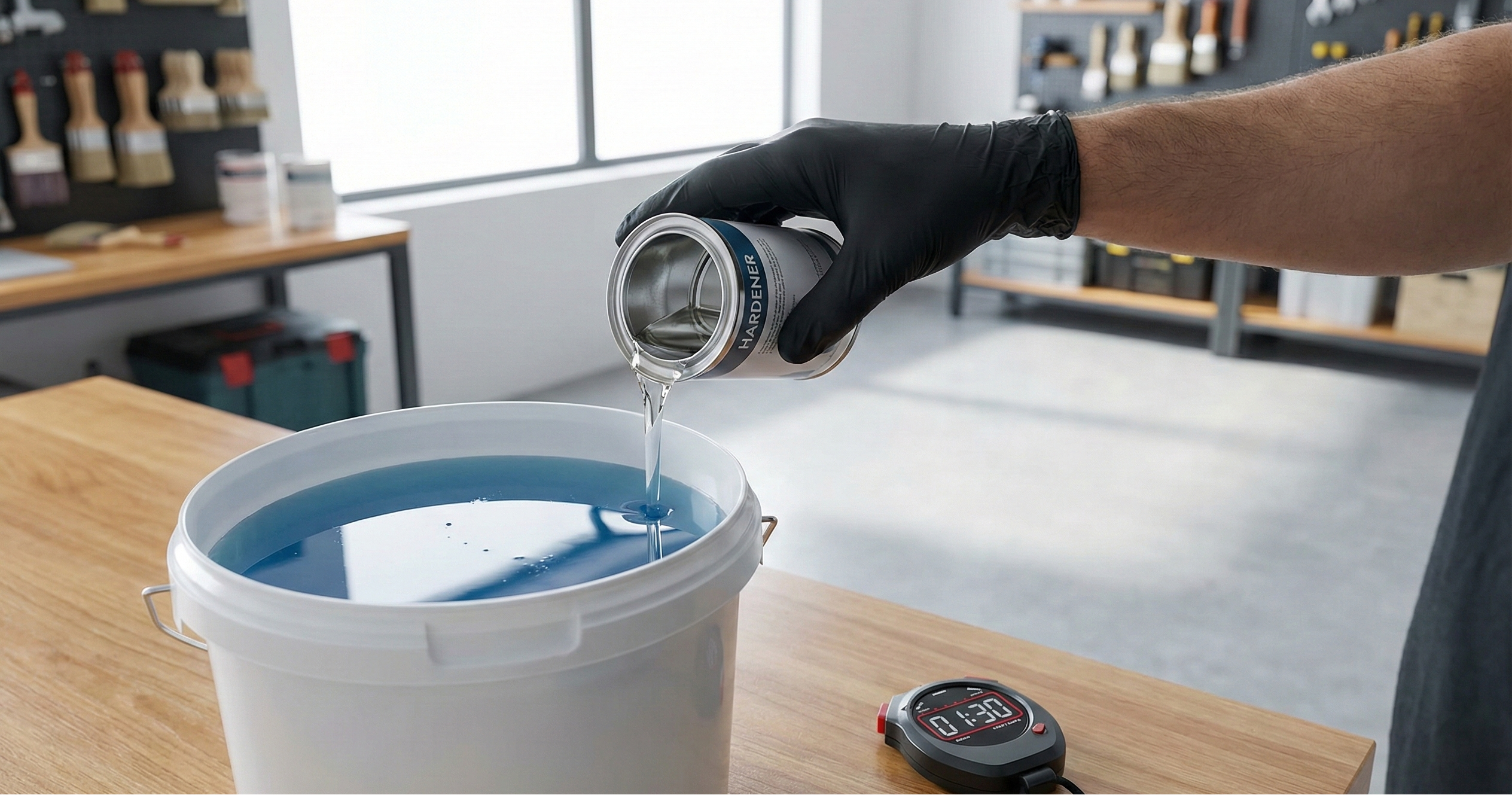
The biggest hurdle to overcome between using a two-pack paint and single pack paint is panic.
When you use standard emulsion paint, you can open the tin, paint a bit, go for lunch, come back, and carry on.
When you use a 2-Pack Epoxy Resin, you are racing against a chemical stopwatch known as Pot Life.
If you misjudge this, you won't just waste paint; you will be left with a bucket of solid plastic and a ruined roller.
But don't worry. Once you understand why resin hardens, you can control the clock.
Here is the guide to mastering Pot Life and keeping your cool during installation.
What is Pot Life?
Pot Life is the amount of time you have to apply the product after mixing Part A (Base) and Part B (Hardener) before it becomes too thick to use.
Unlike air-drying paints, 2-Pack Epoxy Resins cure via a chemical reaction. This reaction generates Heat (known as an Exothermic Reaction).
- The Cycle: You mix the resin → The chemicals react → The reaction creates heat → The heat makes the reaction go faster → The resin gets hotter → The resin goes hard.
The "Mass Effect": Why the Bucket is Dangerous
This is the golden rule of resin flooring: The Resin Hates the Bucket.
If you mix 5kg of Epoxy and leave it sitting in the plastic bucket, the heat generated by the reaction has nowhere to go. It is trapped in the bulk of the liquid.
- Result: The resin will "cook" itself. A product with a 40-minute pot life might turn into a smoking, boiling brick in just 15 minutes if left in the bucket.
The Fix: Pour it out immediately.
As soon as you finish mixing, pour the resin onto the cool concrete floor in a long line (a bead).
By spreading the resin out, you increase the surface area. The heat can escape into the air and the cold concrete, drastically slowing down the reaction and giving you the full working time.
Temperature Matters: Summer vs. Winter
The time printed on the tin (e.g., "30 Minutes") is usually based on a lab temperature of 20°C.
Real life rarely offers us these precision lab conditions.
-
In Summer (25°C+): Heat fuels the reaction. Your 30-minute pot life might shrink to 15 minutes.
- Tip: Keep your unmixed tins in a cool room or a fridge before starting.
-
In Winter (5°C): Cold slows the reaction. Your 30-minute pot life might stretch to 60 minutes.
-
Tip: While this sounds great, if it's too cold, the resin will be thick like treacle and hard to roll.
-
Tip: While this sounds great, if it's too cold, the resin will be thick like treacle and hard to roll.
Shelf Life vs. Working Time vs. Drying Time vs. Curing Time
There are a lot of key time restraints you might see in relation to two-pack paints. Here is a brief explanation of them.
-
Shelf Life: This is simply the "use by" date for the liquid while it sits in the unopened tin. Once this date passes, the chemical catalysts inside may die, meaning the paint could refuse to harden even if you mix it perfectly.
-
Pot Life: This is your urgent countdown once the catalyst is mixed. Because a full bucket of resin generates intense heat (exotherm), it can solidify in as little as 20 minutes if left in the container. You must pour the mixed product onto the floor immediately to dissipate the heat and save the mix.
-
Working Time: This is the window you have to roll the paint out once it is on the cool floor. This is usually longer than the pot life, but you must keep moving; if you try to back-roll the coating once it starts to get sticky (draggy), you will ruin the smooth finish.
-
Curing Time: This defines the difference between "dry" and "hard." While a floor might be dry enough to walk on in socks after 12-24 hours, it often takes 7 full days to reach "chemical cure." Driving a hot car onto the floor before this period is up can tear the coating right off the concrete.
Comparing the Chemistries
|
Resin Type |
Typical Working Time |
Characteristics |
|
Standard Epoxy |
20 - 40 Mins |
The "forgiving" standard. Good for beginners. |
|
Fast Cure Epoxy |
10 - 20 Mins |
Stressful. Only for experienced pros or small repairs. |
|
Polyaspartic |
15 - 25 Mins |
Very fast. Requires a two-person team (one mixing, one rolling). |
Conclusion: How to Survive the Pot Life
-
Don't Mix Everything at Once: If you have a large garage, don't mix all 3 tins. Mix one, apply it, then mix the next.
-
Get it on the Floor: Never leave mixed resin in the bucket while you chat or tape up edges. Pour and go.
-
Watch the Temperature: If it's a hot day, work faster.
Ready to start?
→ Shop for our Epoxy Floor Paints
Share:
Tape Removal Timing: How to Get Crisp Lines Without Ruining Your Edge